
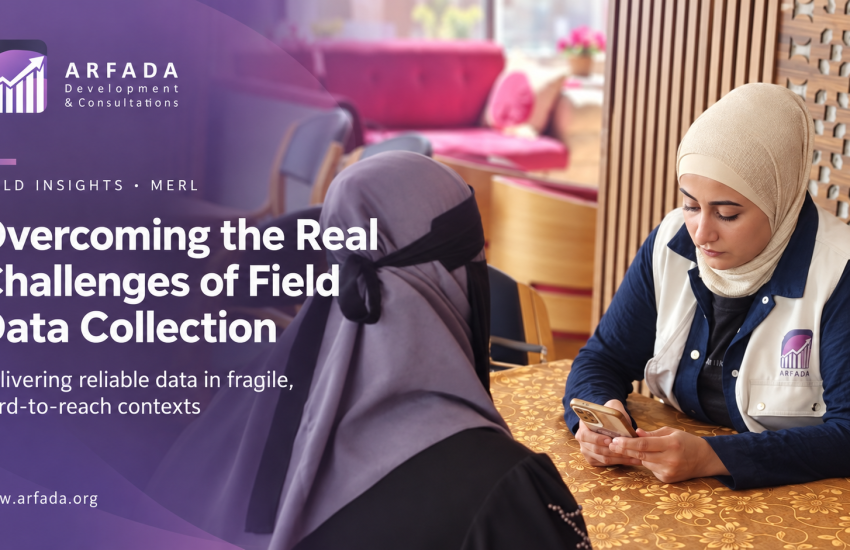
Overcoming the Real Challenges of Field Data Collection
How ARFADA delivers reliable data in fragile, hard-to-reach contexts — and turns field obstacles into dependable evidence.
In monitoring, evaluation and research, the quality of a study is decided in the field. Reliable field data collection in fragile and conflict-affected settings is rarely straightforward — but the way an organization responds to those challenges is exactly what separates dependable evidence from unreliable numbers.
At ARFADA, every evaluation and third-party monitoring assignment brings real-world obstacles. Working in demanding contexts such as Afghanistan — one of the world’s most challenging humanitarian environments — our teams have navigated unreachable respondents, access restrictions, security risks, and data-protection sensitivities. Below, we share how we approach these challenges while protecting data quality, ethics, and the safety of the communities we serve.
1. When contact lists don’t connect
One of the most common challenges in household survey data collection is reaching the sampled respondents. Contact lists are often incomplete: numbers may be out of coverage, incorrect, duplicated, or simply outdated. In one assignment, reaching a target sample of 1,000 respondents required working through lists of more than 7,000 contacts.
Sampled respondents could not be reached because of inaccurate or unreachable phone numbers, threatening the target sample size.
We maintain daily coordination with local and international partners, continuously requesting and validating replacement lists until the required, statistically valid sample is achieved.
2. Respecting data-protection policies
Strong data protection practices are essential — but they can also complicate access to beneficiary contact details, especially for sensitive sectors. Rather than treating this as a barrier, we treat it as a standard to meet.
Some partners cannot share beneficiary names or contact numbers due to their data-protection policies.
We adapt our workflow to the partner’s safeguards — for example, conducting data collection on the partner’s premises, on official devices, with their staff present — so confidentiality is never compromised.
3. Safe, gender-sensitive fieldwork
Inclusive data means hearing from women and men alike. In some contexts, deploying female enumerators and convening women for focus group discussions (FGDs) requires careful, security-conscious planning.
Restrictions on female movement in contexts such as Afghanistan made deploying female enumerators and gathering female participants difficult and sensitive.
We coordinate with security teams and local authorities in advance to obtain the necessary permissions, ensuring female enumerators can work safely and women’s voices are included in the data.
4. Reaching the hardest-to-reach
Some communities are located in remote, insecure, or out-of-network areas where neither in-person visits nor phone calls are straightforward. Remote data collection demands creativity and strong local relationships.
Beneficiaries in the farthest, hardest-to-reach areas could not be visited in person or reached by phone due to lack of network coverage.
We work with local focal points to convene respondents at the nearest accessible point with coverage, and use remote interviewing methods to complete surveys safely and reliably.
5. Securing key informant interviews
Key informant interviews (KIIs) add essential depth — but scheduling them around busy calendars and end-of-year availability can be difficult.
Key informants were often unavailable or unresponsive to email invitations, putting the target number of interviews at risk.
We follow a persistent, multi-channel outreach approach — combining reminders with direct phone calls to confirm appointments — until every targeted interview is completed.
Turning field challenges into reliable evidence
What these situations have in common is a mindset: obstacles in the field are not excuses for weaker data — they are problems to be solved with planning, coordination, and ethical rigor. This is the core of high-quality MERL (Monitoring, Evaluation, Research and Learning) in fragile contexts.
The reliability of an evaluation is not decided in the report. It is decided in the field — in how every challenge is anticipated, managed, and overcome.
By combining trained local enumerators, strong partner coordination, and adaptive, ethically grounded methods, ARFADA ensures that even the most difficult assignments — from Afghanistan to beyond — produce data that partners and donors can trust.
Need reliable data from a difficult context?
Talk to our team about monitoring, evaluation, and field data collection for your next program.
Get in touch