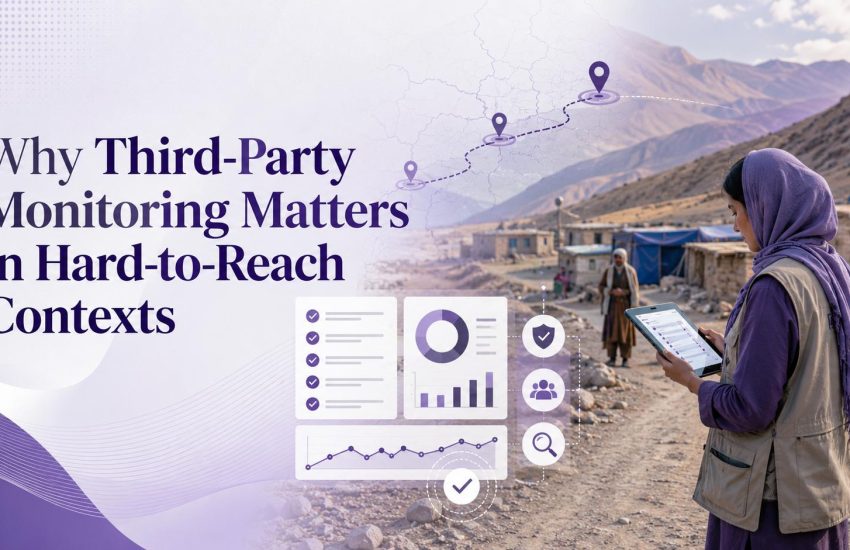
When programs run in areas that donors and headquarters cannot easily visit, how can anyone be sure aid actually reaches the people it’s meant for? Third-party monitoring provides the independent answer.
In fragile and conflict-affected settings, distance is more than a logistical problem — it’s an accountability problem. Security restrictions, access constraints, and remote management mean that the organizations funding and implementing aid often cannot verify, first-hand, what is happening on the ground. Third-party monitoring (TPM) exists to close that gap.
What is third-party monitoring?
Third-party monitoring is the use of an independent organization — separate from the donor and the implementing partner — to observe, verify, and report on how a program is being delivered. Instead of relying solely on self-reported data, stakeholders get an objective, external view of whether activities are taking place as planned, whether they meet quality standards, and whether beneficiaries are genuinely being reached.
Why it matters more in hard-to-reach areas
In accessible contexts, program staff can monitor their own work directly. In hard-to-reach areas, that direct line of sight disappears. TPM becomes essential for several reasons:
- Independent verification. An external monitor has no stake in the results, which makes findings more credible to donors and oversight bodies.
- Access where others can’t go. Specialized monitoring teams with local networks can reach communities that international staff cannot safely visit.
- Early problem detection. Independent monitoring surfaces delivery gaps, quality issues, or risks of diversion before they become serious.
- Stronger accountability. TPM reassures donors, partners, and affected communities that resources are being used as intended.
Third-party monitoring turns “we believe the program is working” into “we can show the program is working.”
What good TPM looks like
Effective third-party monitoring is more than a checklist visit. It combines the right mix of methods — site visits, key informant interviews, focus group discussions, beneficiary surveys, and direct observation — with rigorous data quality controls and clear, actionable reporting. Crucially, it must be conducted with sensitivity to context: monitors need to understand local dynamics, protect the people they speak with, and apply do-no-harm principles at every step.
The bottom line
As humanitarian and development work increasingly takes place in the world’s most difficult environments, independent monitoring is no longer a “nice to have.” It is a core part of responsible programming — the mechanism that keeps aid transparent, accountable, and grounded in reality.
