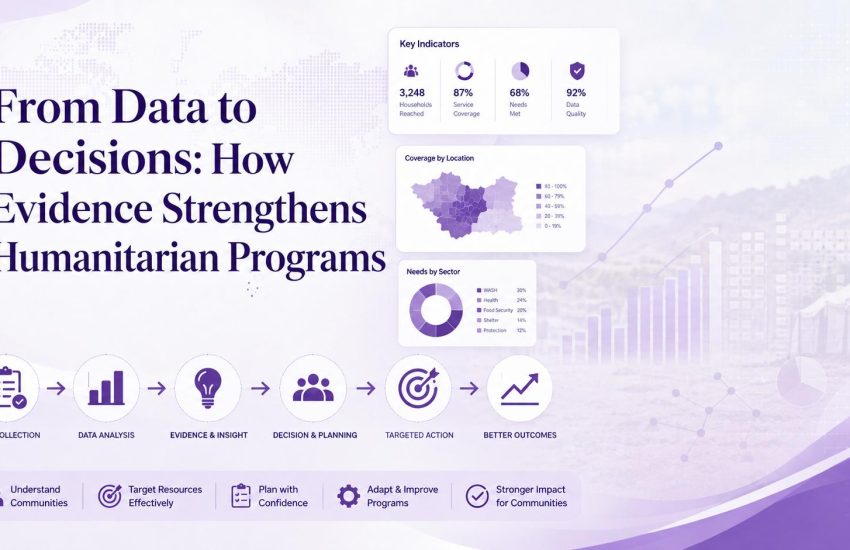
Collecting data is easy. Turning it into better decisions is the hard part — and it’s where monitoring, evaluation, and learning earn their value.
Humanitarian and development organizations generate enormous amounts of information: survey results, monitoring reports, evaluations, feedback from communities. Yet data on its own changes nothing. The real question is whether that evidence actually shapes what organizations decide to do next. This is the heart of MERL — monitoring, evaluation, research, and learning.
The gap between data and decisions
Too often, evidence is collected to satisfy a reporting requirement, filed away, and forgotten. Reports are written but not read; findings are noted but not acted on. Closing the gap between data and decisions requires treating evidence not as a compliance exercise, but as a management tool — something that informs course corrections, resource allocation, and program design in real time.
How evidence strengthens programs
- Course correction. Monitoring data reveals what’s working and what isn’t while there’s still time to adjust.
- Accountability. Evidence lets organizations demonstrate results to donors and, just as importantly, to the communities they serve.
- Smarter resource use. Evaluation findings help direct limited resources toward the approaches that deliver the most value.
- Institutional learning. Systematically capturing lessons means each program builds on the last rather than repeating old mistakes.
Evidence has no value until it changes a decision. The purpose of measurement is not to prove — it’s to improve.
Building a learning culture
The organizations that get the most from their data share a common trait: they treat learning as a habit, not an afterthought. They ask hard questions, welcome uncomfortable findings, and create space to reflect and adapt. Evidence flows into decision-making because the culture expects it to. That shift — from measuring for compliance to measuring for improvement — is what separates programs that plateau from programs that keep getting better.
The takeaway
Strong programs aren’t built on good intentions alone. They’re built on a continuous loop: gather reliable evidence, understand what it means, and act on it. When that loop works, data stops being a report at the end of a project and becomes the engine that drives better outcomes throughout it.
