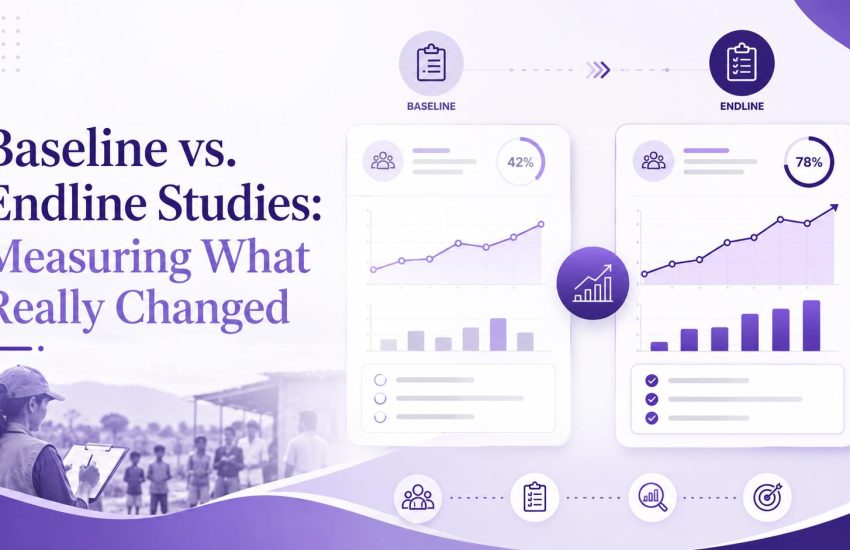
Every program hopes to make a difference. But without a clear starting point and a clear finishing point, “difference” is just a claim. Baseline and endline studies turn that claim into evidence.
One of the most common questions donors ask is simple to state and hard to answer: did this program actually change anything? Answering it credibly requires two measurements taken at two moments in time — and a rigorous method for comparing them. That’s the role of baseline and endline studies.
The baseline: your starting photograph
A baseline study captures the situation before a program begins. It measures the key indicators the program intends to influence — income levels, access to services, knowledge and attitudes, protection risks, and so on — establishing the reference point against which all future change will be assessed. Without a baseline, there is no way to know how far a community has come.
The endline: measuring the distance travelled
An endline study measures those same indicators after the program ends. By comparing endline results against the baseline, evaluators can quantify what changed, in which direction, and by how much. The key word is same: the endline must mirror the baseline in indicators, definitions, and sampling logic. Otherwise you’re comparing apples to oranges.
A baseline without a matching endline is an unfinished sentence. An endline without a baseline is a number with no meaning.
Why the comparison is harder than it looks
Measuring change reliably isn’t just about running the same survey twice. Good baseline–endline design has to account for:
- Comparability. Tools, indicator definitions, and sampling must stay consistent across both rounds.
- Context. External factors — economic shifts, displacement, conflict — can influence results independently of the program.
- Attribution. Distinguishing change caused by the program from change that would have happened anyway.
- Data quality. Consistent field standards across both rounds, often years apart.
From measurement to learning
Done well, baseline and endline studies do more than satisfy a reporting requirement. They tell a story: where a community started, where it ended, and what role the intervention played. That story is what allows organizations to demonstrate impact, strengthen accountability, and design better programs next time.
