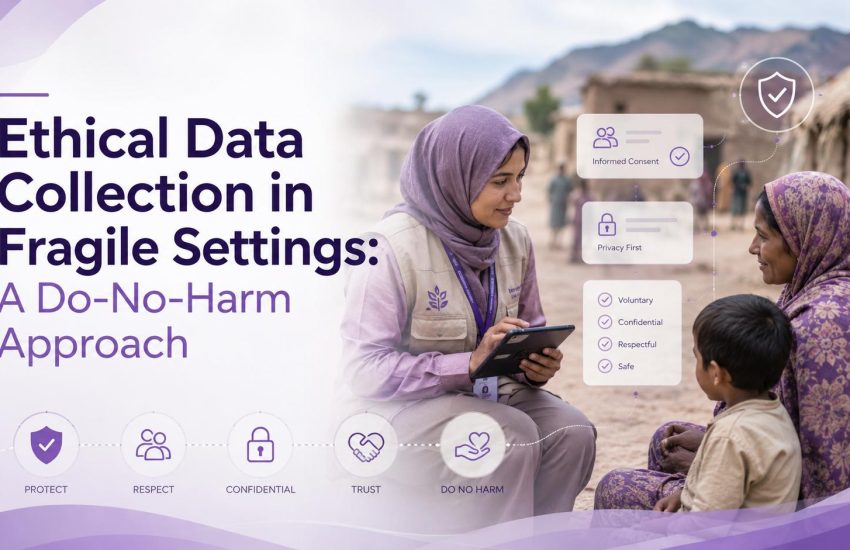
Behind every data point is a person — often someone who has already lived through displacement, conflict, or loss. Collecting data responsibly in these settings is not just good practice; it is an ethical obligation.
In humanitarian and development work, data drives decisions. But in fragile settings, the act of collecting that data carries real risks — to the people being interviewed, to the communities involved, and to the integrity of the findings themselves. Ethical data collection means designing every stage of the process to protect the people at its center.
The do-no-harm principle
“Do no harm” is a foundational concept in humanitarian work: interventions — including research and monitoring — must avoid causing unintended harm to the people and communities they engage. In data collection, this means anticipating how questions, methods, and even the presence of a field team might create risk, and taking deliberate steps to minimize it.
What ethical data collection requires
- Informed consent. Participants must understand what the data is for, how it will be used, and that they can decline or stop at any time — without consequence.
- Confidentiality and data protection. Personal information must be securely handled, anonymized where possible, and never exposed in ways that could endanger participants.
- Sensitivity to vulnerability. Special care for children, survivors of violence, displaced people, and other at-risk groups.
- Gender- and conflict-sensitivity. Recognizing how gender dynamics and local tensions shape who can speak, when, and how safely.
- Referral pathways. Knowing how to responsibly connect participants to support services when needs surface during data collection.
Reliable data and ethical data are not competing goals. In fragile settings, they depend on each other.
Why ethics improves the evidence
Ethical practice isn’t only about protection — it also produces better data. When participants trust that they are safe and respected, they respond more openly and honestly. When field teams are trained in local sensitivities, they reach people others cannot. Ethics and rigor reinforce each other: the most responsible data collection is often the most accurate.
A commitment, not a checkbox
Ethical data collection cannot be reduced to a form signed at the start of an interview. It is a mindset that runs through tool design, enumerator training, field supervision, data handling, and reporting. In the world’s most fragile contexts, that commitment is what separates responsible evidence from extractive research.
